The moment your toddler starts dragging a dining chair across the floor so they can "help" at the counter, you know it is time to think about a toddler step stool kitchen setup.
A good stool can turn that daily tug-of-war into something safer, easier, and a lot less stressful.
It also gives your child a way to join simple routines like washing produce, mixing batter, or watching dinner come together.
For most families, the goal is not to make the kitchen into a classroom.
It is to make everyday tasks more manageable while giving toddlers a safe place to stand.
That is where the right step stool matters.
It should fit your space, support your child’s size, and feel easy to use without becoming one more awkward piece of furniture in the way.
Why a toddler step stool kitchen setup works so well Toddlers want access.
They are curious, eager to copy what adults do, and usually convinced they can do more than they safely should.
When they cannot reach the counter or sink, they improvise with unstable chairs, slippery boxes, or your own distracted help while you are carrying a pot or unloading groceries.
A step stool gives them a designated spot.
That simple change can help with handwashing, snack prep, and low-pressure kitchen participation.
It also supports independence in a way that fits real family life.
Your child can climb up, see what is happening, and feel included without needing to be held every five minutes.
There is also a practical benefit for parents.
A child who can stand at the sink to wash hands or watch you rinse fruit is often easier to supervise than one circling the kitchen looking for trouble.
It does not solve every mealtime challenge, but it can make the room work better for everyone.
What to look for in a toddler step stool kitchen The best choice usually comes down to stability first, convenience second.
If a stool wobbles, slides, or tips when your child climbs, nothing else matters.
A wide base, solid frame, and secure steps are worth prioritizing over extras.
Many parents also look for guardrails or enclosed sides, especially for younger toddlers who are still getting used to climbing.
These can add reassurance, but they also make the stool bulkier.
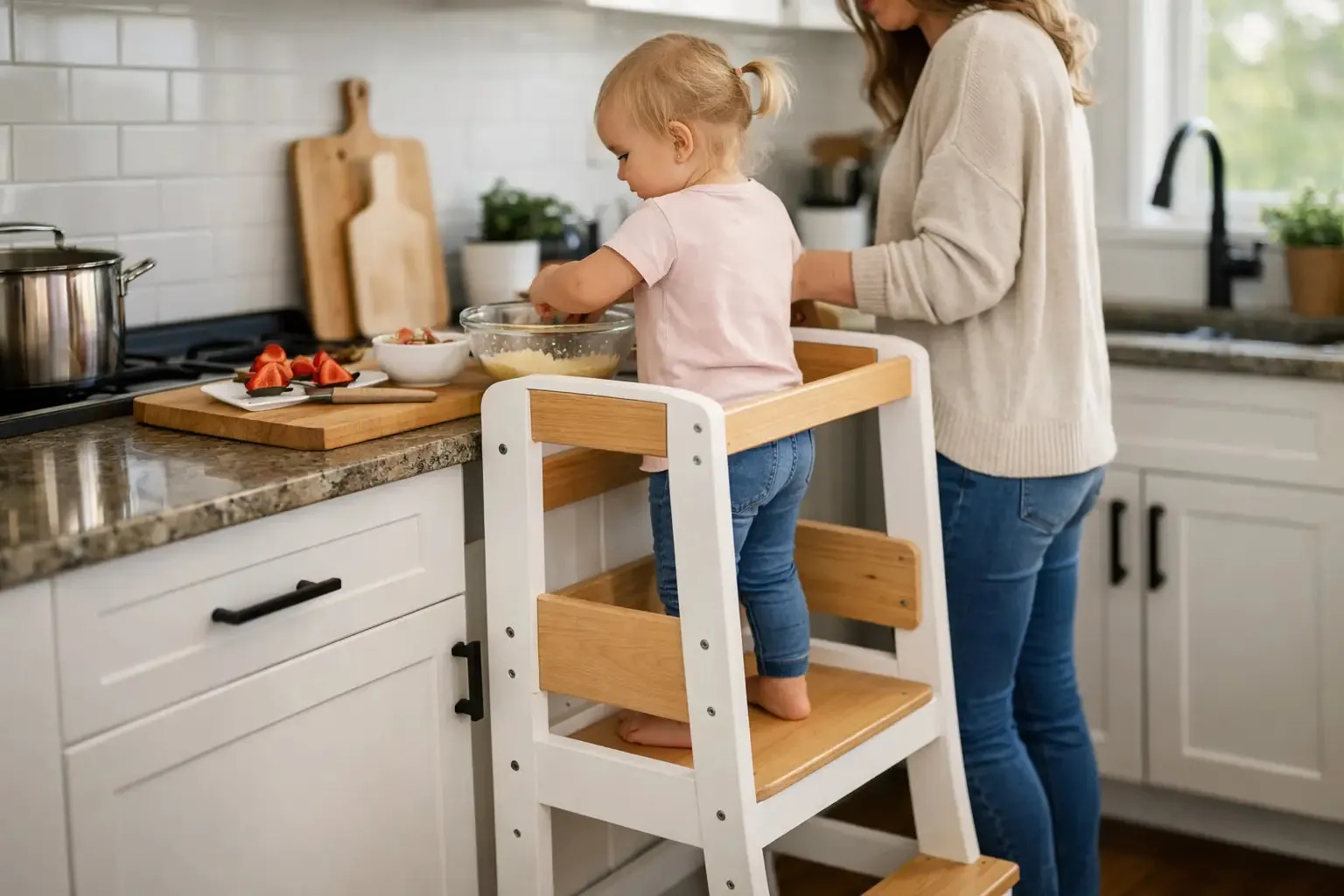
If you have a small kitchen, a compact design may fit your daily routine better than a larger learning tower style.
The trade-off is that a smaller stool may offer less support for children who are still unsteady.
Wooden stools often feel sturdy and look more furniture-like, which some families prefer if the stool will stay out all the time.
Plastic options are usually lighter and easier to move or wipe down.
It depends on whether you care more about weight, appearance, or how often the stool will be moved between the kitchen, bathroom, and other rooms.
Height and fit matter more than parents expect A stool that is too short can be frustrating.
Your child climbs up and still cannot comfortably reach the counter or sink.
A stool that is too tall can create awkward posture or leave too little clearance under the counter edge.
Ideally, your toddler should be able to stand with enough height to participate comfortably, without leaning dangerously forward.
Adjustable models can be helpful if you want longer use, especially as your child grows from toddler stage into preschool years.
But fixed-height stools can still be a good buy if the dimensions match your home and your child right now.
Non-slip details are worth paying attention to Small features matter in a busy kitchen.
Non-slip feet can help keep the stool from shifting on tile or hardwood.
Textured steps reduce slipping with socks or slightly wet feet.
Smooth-looking designs can be appealing, but if they sacrifice grip, they may not hold up well to real family use.
Safety matters more than style It is easy to focus on appearance because the stool will likely live in a visible part of your home.
But kitchen safety should guide the decision.
A stylish stool that is awkward to climb or too easy to tip is not a smart buy.
Look closely at the base and how the stool handles movement.
Toddlers do not climb carefully every time.
They rush, lean, bounce, and try to twist around to show you something.
A good stool should feel planted even when your child uses it like a toddler, not like a product tester in a showroom.
Even a stable stool should not sit too close to a hot stove, knife block, or heavy appliances.
Counter access can be useful, but not every part of the kitchen should become reachable.
Many parents find the sink area is the most practical first station because it supports handwashing and simple supervised tasks.
Learning tower or simple step stool? This is where family routines really shape the decision.
A learning tower style toddler step stool kitchen design usually has higher sides and a more enclosed standing platform.
It is often better for younger toddlers or children who want to stay involved for longer stretches, like helping stir, pour, or watch meal prep.
A simple step stool is usually smaller, lighter, and easier to tuck away.
It works well if your main goal is helping your child reach the sink or counter for quick tasks.
It may also be the better fit for apartments or narrower kitchens where floor space is limited.
If your child is just starting to climb independently, the enclosed design may offer more confidence.
If your child is older, steadier, and only needs a boost for short moments, a compact stool may be more practical.
How it fits into daily family routines The best products are the ones that actually get used.
A toddler step stool kitchen setup works best when it supports routines you already have instead of adding extra work.
For some families, that means a child can wash hands before meals without being lifted.
For others, it means joining in on small kitchen jobs like dropping berries into a bowl, helping mix pancake batter, or watching lunch get packed.
These are simple moments, but they can reduce resistance around routines because toddlers often cooperate more when they feel included.
That said, more access also means more supervision.
A stool is not a free pass to let your child explore the counters while you answer emails in the next room.
It is a tool that makes shared routines easier, not something that replaces attention.
Think about storage before you buy This part gets overlooked.
If the stool is too heavy to move easily or too bulky for your kitchen layout, it may become annoying fast.
Some families are happy to keep one in place all day.
Others need something they can slide aside after each use.
Before buying, picture where it will live when your child is not using it.
If that answer is "in the middle of the floor," you may want a smaller or foldable option.
Common mistakes parents make One common mistake is choosing based only on age recommendations.
Age ranges can be useful, but height, coordination, and confidence matter just as much.
A cautious three-year-old may do better with more support than a very agile two-year-old.
Another mistake is assuming all stools are basically the same.
In practice, differences in base width, platform size, step spacing, and grip can change how safe and convenient the stool feels at home.
Parents also sometimes buy for the perfect scenario instead of the everyday one.
If you imagine elaborate baking sessions every weekend but really just need a safe way for your toddler to wash hands and watch you prep dinner, a simpler stool may serve you better.
When a toddler step stool kitchen setup is worth it If your child constantly wants to be at counter height, the answer is usually yes.
A well-chosen stool can make kitchen time smoother, reduce risky improvising, and support small moments of independence that feel big to a toddler.
It is especially useful for families who spend a lot of time in the kitchen and want practical products that support daily routines instead of creating clutter.
That is why many parents look for curated, easy-to-shop options rather than sorting through endless choices.
A straightforward product that fits your home and works from day one is often the best value.
If you are shopping for one, focus on stability, fit, and how your family actually uses the kitchen.
The right stool does not need flashy features.
It just needs to help your toddler safely step into everyday life, one counter-height moment at a time.