
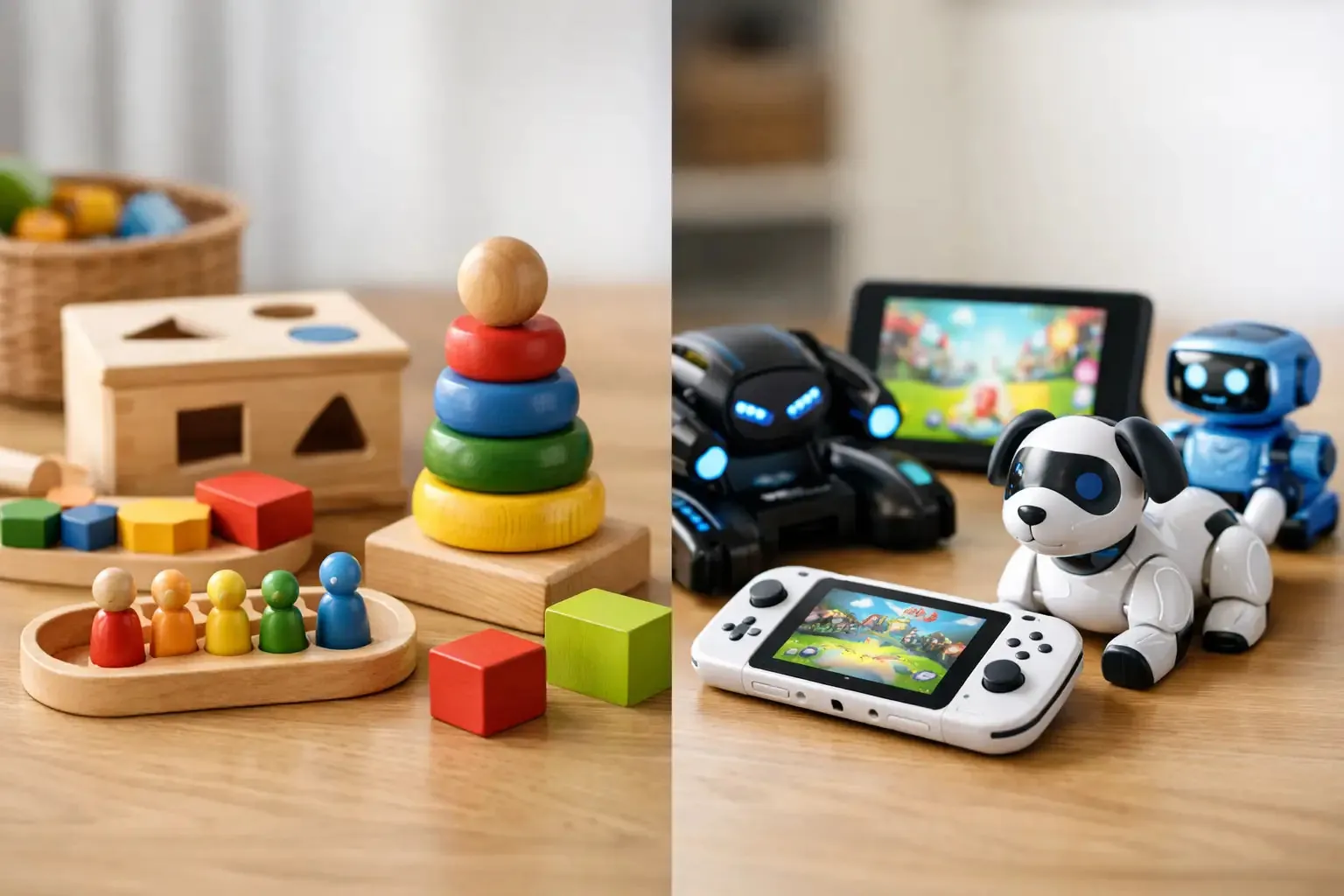
A toy that holds your child’s attention for 20 minutes can feel like a win.
But when you’re deciding between montessori toys vs electronic toys, the better question is what kind of attention that toy is building in the first place.
For many parents, this choice is less about picking a side and more about finding toys that actually fit daily life.
Some toys light up, sing, and react with a button press.
Others are quieter, simpler, and leave more room for hands-on play.
Both can have a place, but they support different kinds of learning, focus, and independence.
Montessori toys vs electronic toys: what’s the difference? Montessori toys are usually designed around active, child-led play.
They tend to be simple, hands-on, and focused on one skill at a time, like stacking, sorting, scooping, matching, or practicing fine motor control.
Electronic toys are built around sound, lights, buttons, motion, or programmed responses.
Some are clearly educational and teach numbers, letters, songs, or cause and effect.
In either case, the toy often leads the interaction by rewarding a press, cue, or action with instant feedback.
That difference matters because children do not just play with toys.
They also learn how to approach problems, how long to stay with an activity, and whether they expect stimulation to come from outside or from their own effort.
Why many parents lean toward Montessori toys Montessori-style play appeals to parents who want toys that are easy to understand, easy to rotate, and useful for everyday development.
A wooden shape sorter, busy board, or stacking set may look basic compared with a toy that flashes and talks, but simple often means more flexible.
A child can use the same toy in more than one way.
Blocks can become a tower, a pretend cake, a sorting game, or a lesson in balance.
That kind of open-ended play helps with creativity and problem-solving because the child is making choices instead of following a script.
Montessori toys also tend to support concentration.
Since there are fewer distractions, children often spend more time repeating the same motion, adjusting their grip, or trying again after a mistake.
Repetition may not look exciting to adults, but it is how young children build real skill.
There is also a practical side that parents appreciate.
These toys are often quieter, easier to store, and less likely to overwhelm a room with noise.
For families trying to keep playtime calm and manageable, that can be a real advantage.
Skills Montessori toys often support The biggest strength of Montessori toys is how clearly they map to early developmental tasks.
Toddlers are learning to pour, stack, fit, twist, open, close, carry, and sort.
Toys that focus on these actions help children practice real-world coordination.
When a toy has a clear purpose and no complicated settings, kids can often use it on their own.
A child who can choose a toy, use it, and put it away without much help is learning more than one skill at a time.
Where electronic toys can be useful Electronic toys are not automatically a bad choice.
In fact, some can be genuinely helpful, especially when used in moderation and matched to a child’s age.
For babies and younger toddlers, simple electronic toys can teach basic cause and effect.
That kind of response can feel rewarding and can hold interest long enough to build early motor control.
For older toddlers and preschoolers, electronic toys sometimes support music exposure, memory games, alphabet familiarity, or guided prompts.
If a child loves songs, voice repetition, or interactive feedback, these toys can add variety to playtime.
They can also be useful in specific moments.
A parent may want a toy that quickly engages a child during travel, while making dinner, or during a short waiting period.
In those situations, a responsive toy can be convenient and realistic for family life.
The trade-offs with electronic toys The main downside is that some electronic toys do too much.
If the toy talks constantly, changes modes quickly, or offers nonstop stimulation, the child may become more passive during play.
Instead of exploring, testing, and repeating an action, they may just trigger effects.
That does not mean all screen-free electronics are harmful.
A toy with a few useful functions is different from one that bombards a child with noise and distraction.
Another issue is limited play value over time.
Some electronic toys are exciting at first but lose appeal once the child has heard every sound or figured out every button.
A simpler toy often lasts longer because the child keeps bringing new ideas to it.
Montessori toys vs electronic toys by age Age makes a big difference in what works best.
For babies, both categories can offer something useful, but simpler is usually better.
Soft rattles, grasping toys, texture toys, and basic cause-and-effect items often do enough without overstimulation.
For toddlers, Montessori toys usually start to shine.
This is the stage when children want to carry objects, place items into containers, build, sort, and imitate daily life.
Toys that support these actions tend to match toddler development very well.
For preschoolers, the decision depends more on personality and routine.
Some children thrive with open-ended materials and can stay engaged for long stretches.
Others enjoy occasional interactive toys that bring in music, sound, or guided play.
At this stage, balance often works better than extremes.
What matters more than the label Not every wooden toy is Montessori, and not every electronic toy is low quality.
Labels can help, but they should not replace common-sense shopping.
A better way to evaluate any toy is to ask a few practical questions.
Does it encourage your child to do something, or mostly watch and react? Can it be used in more than one way? Does it match your child’s current skills without being too easy or too frustrating? And just as important, will it actually fit your home and routine? A toy can be beautifully designed and still be wrong for your family.
If it requires constant supervision, takes forever to set up, or does not hold your child’s interest, it may not earn its space.
How to choose the right mix for your home If you are trying to decide what to buy next, think in terms of balance rather than categories.
Many families do well with mostly hands-on toys and a small number of electronic options.
A practical toy collection often includes open-ended staples, skill-based toys, and a few novelty items.
The staples are the ones your child can return to often, like stackers, puzzles, building sets, pretend-play basics, or fine motor toys.
These are usually the best value because they support repeated play.
Electronic toys work better as occasional extras than as the center of the playroom.
When every toy lights up and sings, children can start expecting that level of stimulation all the time.
A calmer toy mix usually makes it easier for them to focus.
A child does not need everything out at once.
Fewer visible options can lead to better play, especially with Montessori-style toys that reward concentration.
A simple buying mindset for parents When comparing montessori toys vs electronic toys, the smartest choice is rarely about trends.
It is about what your child will actually use and what kind of play you want to encourage at home.
If your goal is independent play, concentration, and hands-on skill building, Montessori toys usually offer more long-term value.
If your goal is occasional variety, quick engagement, or interactive feedback, an electronic toy may be a reasonable addition.
For most families, the best answer is not all one or all the other.
A few well-chosen toys that support how your child learns will usually do more than a large pile of toys that simply make noise.
If you are shopping for younger kids, it helps to choose toys that leave room for curiosity.
Children tend to show you what works when the toy gives them space to lead.