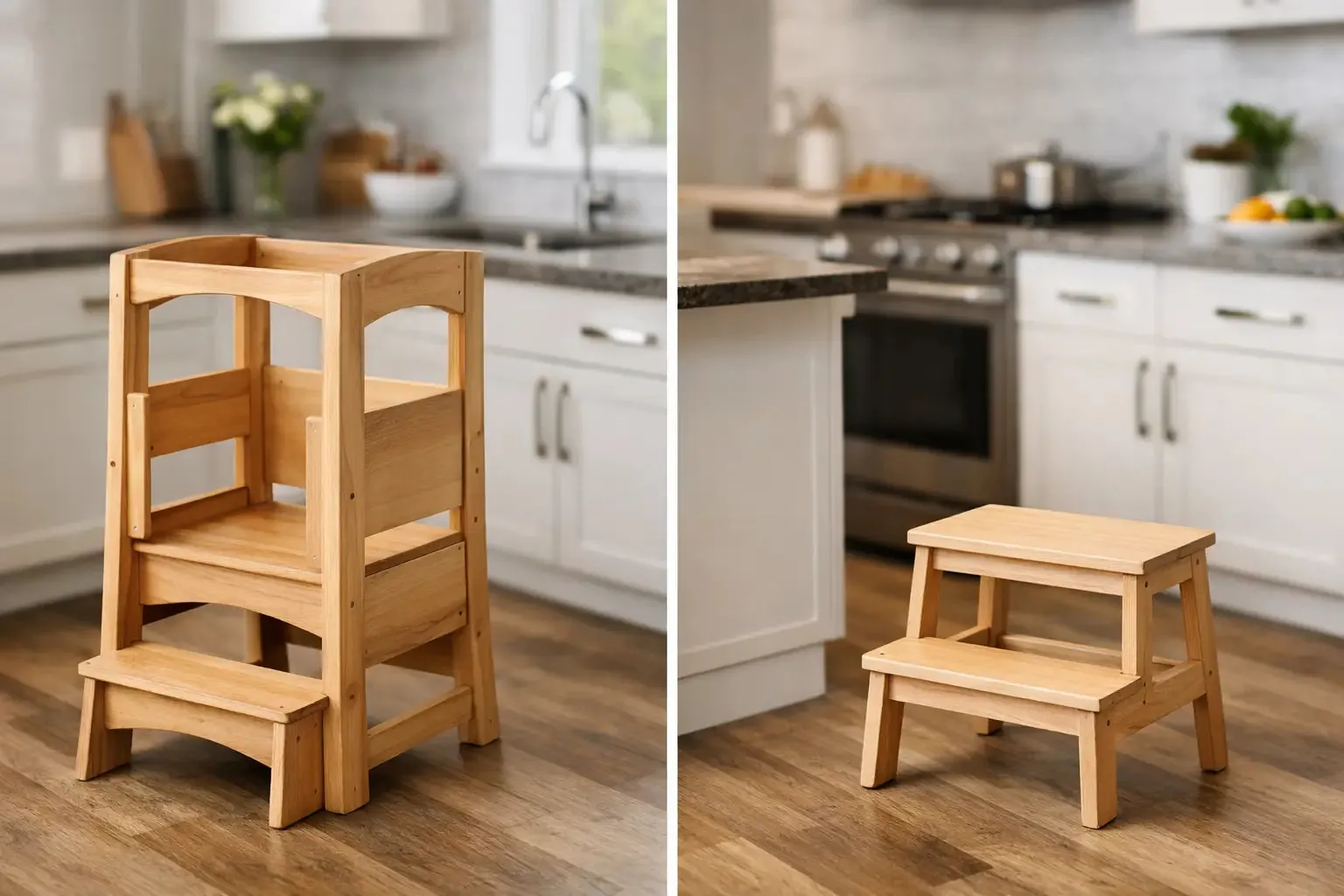
If you’ve ever tried to cook dinner while your toddler insists on "helping," you already know why the learning tower vs step stool question matters.
Both help kids reach sinks, counters, and bathroom spaces, but they work very differently in day-to-day family life.
For some homes, a simple step stool is all you need.
For others, a learning tower makes routines easier, safer, and less stressful.
The right choice depends on your child’s age, confidence, your available space, and how often you want them involved in everyday tasks.
Learning tower vs step stool: the basic difference A learning tower is a raised platform with enclosed sides that lets a young child stand at counter height with more support.
It’s designed for toddlers who want to participate in activities like washing produce, mixing batter, brushing teeth at a higher sink, or watching a parent work in the kitchen.
It gives a child an extra boost, usually with one or two steps and an open design.
It works well for kids who already have decent balance and only need a quick lift to reach something.
That difference sounds small, but it changes how each one feels in real use.
A learning tower is more like a standing station.
A step stool is more like a portable helper.
When a learning tower makes more sense A learning tower is usually the better pick for younger toddlers, especially those who are curious but still a little wobbly.
The side rails help create a more secure standing area, which can give both kids and parents more confidence during daily routines.
In the kitchen, that extra support matters.
A toddler who wants to stir pancake mix or rinse strawberries is less likely to step backward off a learning tower than off an open stool.
That does not make it risk-free, but it does make supervised participation easier.
It also tends to work better for longer activities.
If your child likes to stay at the counter for ten or fifteen minutes, a learning tower gives them a clearer place to stand.
They are not climbing up, shifting around, and hopping down as often.
This can be especially helpful if you follow a Montessori-style setup at home or simply want your child more involved in practical routines.
Hand washing, snack prep, and simple cleanup all become easier when your child has a stable place to stand.
When a step stool is the better buy A step stool often makes more sense if your child is a little older, more coordinated, or only needs occasional help reaching a sink or shelf.
It’s also a smart choice if you need something compact, affordable, and easy to move around the house.
For many families, the bathroom is where a step stool shines.
A child can pull it up to the sink, wash hands, brush teeth, and move on.
It handles quick tasks well without taking up much room.
If you live in an apartment, have a smaller kitchen, or already feel crowded by baby gear, the lighter footprint is a real advantage.
You can slide it beside a vanity, tuck it in a pantry, or move it from room to room without much effort.
Learning towers usually cost more because they use more material and have a larger structure.
If your child is already steady on their feet, a step stool may give you what you need without paying for features you won’t use for long.
Safety matters, but so does the stage your child is in Parents often start with safety, and that’s fair.
In a straight learning tower vs step stool safety comparison, the learning tower usually offers more support for younger children.
The enclosed design helps reduce side slips and backward stepping.
Still, safety is not just about the product.
It’s also about whether it matches your child.
A cautious, balanced three-year-old may use a step stool just fine with supervision.
A newly independent toddler who loves climbing everything may do much better in a learning tower.
A stool or tower with a stable base and non-slip footing is more useful than one that slides easily on hard floors.
Adult supervision matters every time, especially around hot food, sharp tools, running water, or bathroom counters.
It also helps to think about behavior, not just age.
Others bounce, twist, and treat every household item like playground equipment.
The best option is the one your child can use safely during real routines, not just the one that looks good in a product photo.
Space and storage can decide it fast Even if a learning tower sounds ideal, it still has to fit your home.
These are larger pieces, and in many kitchens they become part of the room rather than something you put away after each use.
That can be a plus if you use it every day.
Many families are happy to keep one near the counter because it earns its spot.
But if your kitchen already feels tight, a bulky tower can quickly become one more thing to step around.
It’s easier to carry, easier to store, and easier to share between the bathroom, closet, and kitchen.
If you want one product for several spaces, the stool is often the more practical buy.
This is where shopping convenience matters.
It’s easy to get excited about the idea of a learning tower, but the better purchase is the one that fits your actual space and routines.
Kitchen use is where the biggest difference shows up If your main goal is getting your child involved in cooking or food prep, a learning tower usually gives you a better setup.
It puts them at counter height in a more secure position and makes side-by-side activities feel more manageable.
That can turn daily tasks into something smoother.
Your child can watch, help, and stay engaged while you work.
For many parents, that alone makes the larger size worth it.
A step stool can still work in the kitchen, especially for older toddlers and preschoolers.
But it tends to be better for shorter tasks like washing hands before meals, grabbing a napkin, or helping for a minute or two.
For longer kitchen sessions, it may feel less stable and less contained.
If your child wants to be involved often, not just occasionally, a learning tower usually supports that routine better.
How long will your child use it? A step stool often has the longer overall lifespan.
Kids can use it for years, even after the toddler stage, because they’ll still need help reaching sinks, beds, toilets, and shelves.
A learning tower tends to have a more specific window of use.
It is especially valuable during the stage when children want independence but still need more support.
Once they grow taller and steadier, many families transition to a step stool.
That does not mean a learning tower is a short-term mistake.
If it gets used daily during a high-need stage, it can be well worth it.
But if you are trying to buy one item with the broadest long-term use, the step stool has an edge.
So which one should you choose? Choose a learning tower if your child is a younger toddler, loves being involved at counter height, and needs more support during tasks like cooking, washing, or hands-on play.
It’s often the better fit for families who want to make shared routines easier and safer.
Choose a step stool if your child is more stable, your space is limited, or you want a simple, budget-friendly option for quick reach tasks around the house.
It’s practical, versatile, and easier to move wherever you need it.
For some families, it is not really learning tower vs step stool forever.
It is learning tower now, step stool later.
That progression often makes sense because children’s needs change fast in the toddler and preschool years.
If you’re browsing family essentials and want a product that supports daily routines without overcomplicating the choice, focus on how your child actually uses your space right now.
The best pick is the one that makes everyday moments a little easier, a little safer, and a lot less chaotic.