
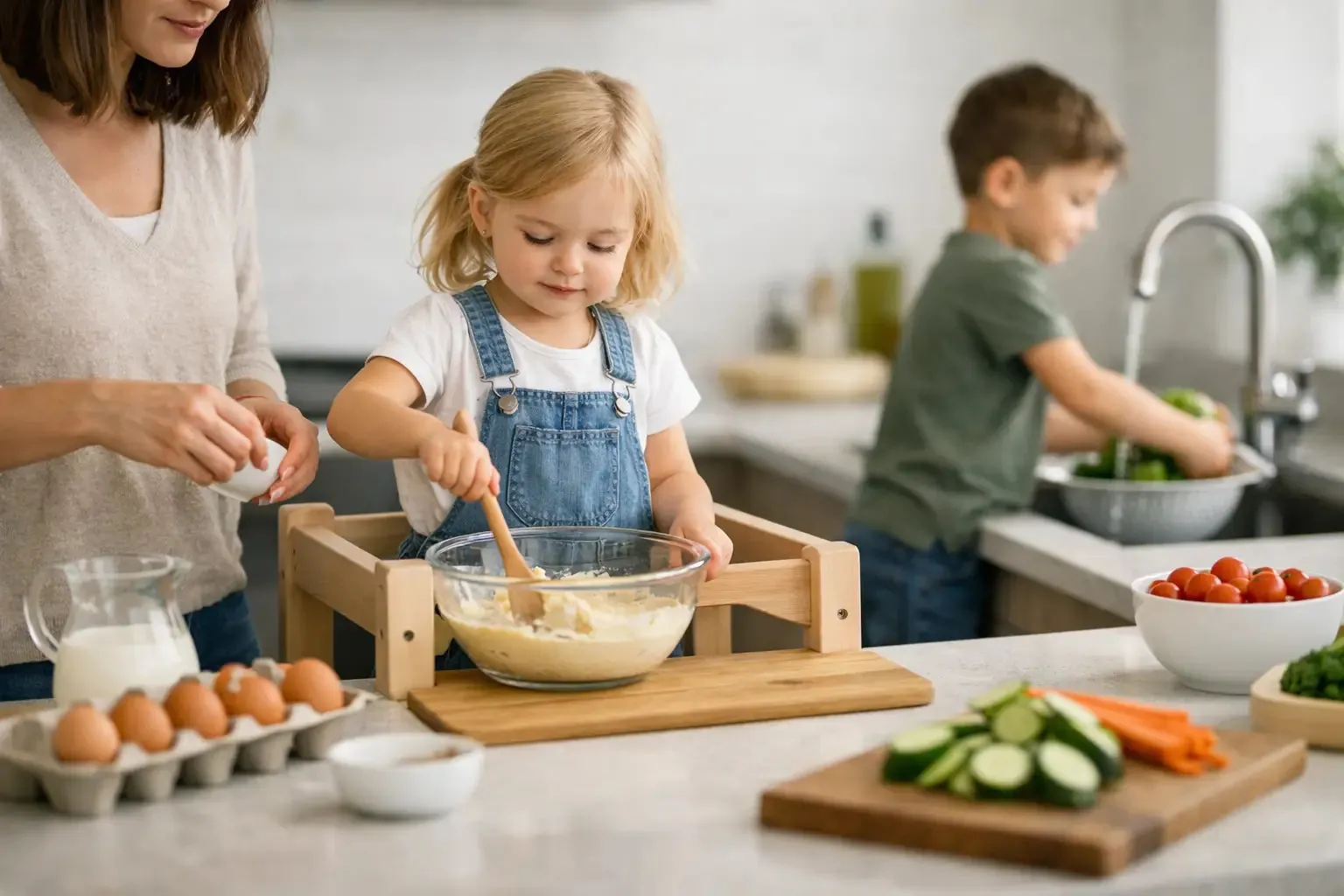
Breakfast is half-made, your toddler wants to see what you’re doing, and standing on a chair feels like a bad idea.
That’s usually the moment parents start looking into kids learning tower benefits.
A learning tower gives young children a stable, elevated place to stand so they can safely join everyday routines instead of watching from the floor - or climbing onto furniture to get closer.
A good learning tower helps with safety, supports independence, and turns ordinary moments like washing fruit or mixing batter into hands-on learning.
It is not a magic fix for every busy morning, but it can make daily life easier while giving toddlers a better way to participate.
What are kids learning tower benefits in real life? The biggest benefit is access.
Toddlers are naturally curious, but most counters, sinks, and workspaces are built for adults.
A learning tower brings a child up to a usable height, which means they can be involved in what is happening instead of constantly asking to be picked up.
That small shift often changes the whole routine.
A child who can stand securely at the counter may spend more time engaged, less time tugging on a parent’s leg, and more time practicing simple skills.
Families often use learning towers in the kitchen, but they can also help at the bathroom sink, craft table, or any supervised area where a child wants to be part of the action.
A learning tower can make participation safer One reason parents shop for a learning tower is that kids tend to find their own way up anyway.
If a toddler wants to watch you cook, they may try climbing a dining chair, bar stool, or even a drawer.
None of those options are designed for safe standing and supervised activity.
A learning tower is usually built with a wider base and side rails or enclosed support, which gives children a more secure place to stand than a standard chair.
That does not remove the need for supervision, especially around hot pans, knives, or cleaning products, but it can reduce the wobble and risk that comes with makeshift setups.
A learning tower is safer than many alternatives, not fully risk-free.
Parents still need to place it on a flat surface, keep it away from obvious hazards, and stay close while their child is using it.
Independence starts with everyday routines A lot of kids learning tower benefits come down to one word: independence.
Young children like doing things for themselves, even when they are not very fast at it yet.
A tower gives them a better chance to try.
In the kitchen, that might mean rinsing berries, stirring pancake mix, tearing lettuce, or helping place toppings on a pizza.
In the bathroom, it could mean reaching the sink for handwashing or brushing teeth with less lifting from a parent.
These are small moments, but they build confidence because the child is not just observing - they are participating.
That independence can also help reduce frustration.
Toddlers often melt down when they want to help but physically cannot reach or manage the space.
A learning tower does not solve every power struggle, but it can remove one very common barrier.
It supports practical skill-building Parents often think of a learning tower as kitchen furniture, but it is really a tool for practice.
When children stand at the right height, they can use both hands more effectively, focus longer, and repeat simple tasks that build coordination.
Scooping, pouring, wiping, sorting, peeling, washing, and stirring all work different muscle groups and hand movements.
Over time, those repeated actions support fine motor development and body awareness.
Kids also start learning how routines work.
They see what comes first, what comes next, and how small jobs fit into family life.
That practical learning is one reason Montessori-style products stay popular.
The goal is not to make a child perform perfectly.
It is to give them real, age-appropriate ways to join in.
Confidence grows when kids feel included Toddlers notice when adults trust them with real tasks.
Giving a child a safe place to stand beside you sends a simple message: you belong here too.
When a child helps crack eggs, wash vegetables, or clean up a spill, they start to see themselves as capable.
Even if the task takes longer, the experience can be valuable.
Children often become more willing to cooperate when they feel included instead of managed from the sidelines.
Some parents find that a child who is involved in meal prep becomes more interested in tasting food.
That is not guaranteed - picky eating has many causes - but participation can make unfamiliar foods feel less intimidating.
Kids learning tower benefits go beyond the kitchen Most people picture a tower next to a kitchen counter, and that is still the most common setup.
But many families use one in other parts of the home.
At the bathroom sink, it can make handwashing and tooth brushing easier.
In a playroom or craft space, it can help with drawing, sensory bins, or simple projects at a higher surface.
Near a laundry area, a child may enjoy helping sort socks or pass cloths to fold.
The benefit is the same in each case: better access to a workspace that usually sits out of reach.
That flexibility can make a tower feel more useful over time.
If your home has limited space, it helps to think about whether the piece can move between rooms or serve more than one daily routine.
What a learning tower does not do A practical buying decision starts with honest expectations.
A learning tower will not automatically make a toddler calmer, more patient, or easier to cook with.
Some children love being involved right away.
Others may use it for five minutes and then lose interest.
It also takes up floor space, which can be a real issue in smaller kitchens.
And while many families use them for years, the value depends on your child’s age, interest, and your home setup.
If your counters are crowded or your routine rarely allows for supervised participation, you may not use it as much as expected.
That does not mean it is not worth buying.
It just means the best choice depends on how your family actually lives, not on a picture-perfect routine.
How to tell if your family will use one often If your toddler constantly wants to be picked up to watch you cook, wash dishes, or use the sink, a learning tower may quickly become part of your daily routine.
It can also be useful if you are trying to encourage more independent handwashing, food prep participation, or simple helper tasks at home.
On the other hand, if your child is still very young and unsteady, or if your household rarely spends time in shared kitchen tasks, you may want to wait.
The best timing often lines up with a stage when a child is mobile, curious, and eager to imitate what adults are doing.
When shopping, look for practical details that match your space and routine.
Stability matters more than fancy extras.
Easy-to-clean surfaces help in messy kitchens.
A size that fits your counter area without becoming an obstacle is also worth paying attention to.
For many parents, simple and sturdy wins.
Why many parents see it as a daily-use item Some kids’ products feel useful for a week and then get pushed into storage.
A learning tower can be different because it fits into routines that already happen every day.
Cooking dinner, washing hands, preparing snacks, and cleaning up are not special occasions.
They are repeated moments where young children want access.
That is what makes the value easier to see.
You are not only buying a piece of furniture.
You are making it easier for your child to join regular home life in a way that feels safer and more practical.
For families who want simple products that support real routines, that is where the strongest kids learning tower benefits show up.
It is less about adding one more thing to the house and more about making the things you already do easier to share.
If your child is ready to help, a well-chosen learning tower can turn everyday tasks into more confident, connected moments.