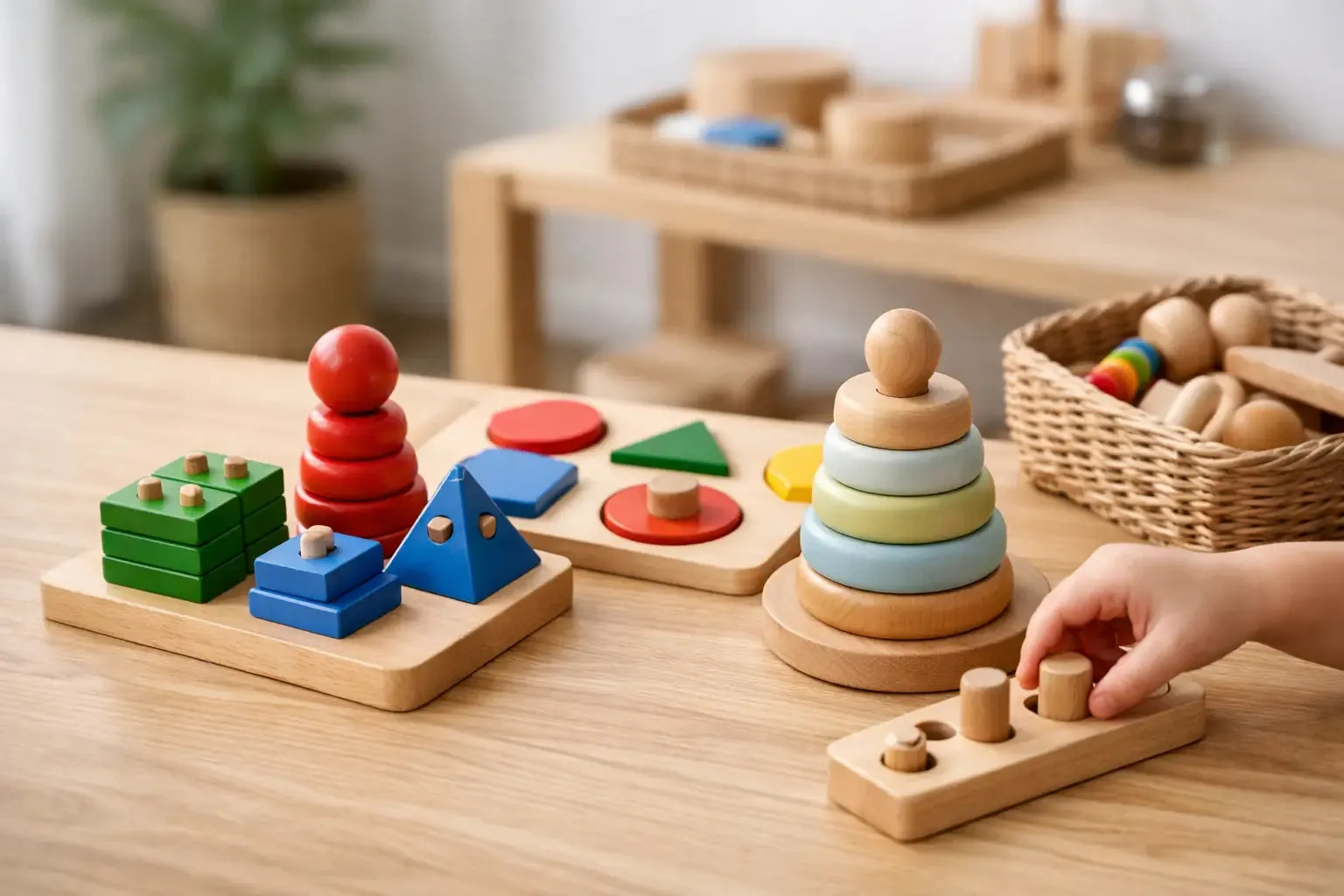
You do not need a playroom full of wooden toys to figure out how to choose Montessori toys.
What helps most is knowing what your child is working on right now - stacking, grasping, matching, pouring, sorting, or pretending - and choosing a toy that supports that stage without doing all the work for them.
A toy can look beautiful, say it is Montessori-inspired, and still miss the mark for your child’s age or attention span.
The best choice is usually simpler than it seems: one toy, one clear purpose, and a level of challenge that keeps your child interested without leading to frustration.
How to choose Montessori toys without overthinking it Montessori toys are generally designed to support independent play, hands-on learning, and real skill-building.
In everyday shopping terms, that means you are looking for toys that invite your child to do something active - not just watch lights flash or push a button for entertainment.
A good Montessori-style toy usually has a clear function.
A shape sorter teaches matching and problem-solving.
A stacking set helps with hand-eye coordination and size awareness.
A busy board can support fine motor practice with zippers, buckles, and latches.
The toy gives your child a job to do, and the learning happens through repetition.
That does not mean every toy needs to be plain or serious.
It means the toy should leave room for the child to lead.
If a product is noisy, overly complicated, or packed with features that distract from the main activity, it often holds attention for a shorter time than a simpler toy would.
Start with your child, not the label The fastest way to make a smart choice is to look at your child’s current abilities and interests.
Age guidelines are helpful, but they are only a starting point.
Two toddlers the same age may need very different types of toys.
If your baby is reaching, grasping, and bringing everything to their mouth, they are in a sensory and motor stage.
Simple rattles, grasping toys, soft balls, and object permanence boxes may be more useful than anything with multiple steps.
If your toddler wants to open drawers, carry cups, and imitate what you do in the kitchen, practical life toys and child-sized tools may hold their attention longer than a basic plush toy.
Instead of asking, "Is this toy Montessori enough?" ask, "What skill does this support for my child right now?" That question usually leads to a better purchase.
What to look for in Montessori toys When you are comparing options, focus on a few basics that matter in real life.
Toys with one main use are often easier for young children to understand and return to independently.
That does not mean a toy has to be boring.
It just means the activity should be obvious enough that your child can engage without constant adult direction.
Since these toys are often handled repeatedly, look for materials that feel sturdy and safe.
Wood is common, but it is not the only good option.
A well-made fabric toy, silicone stacker, or durable child-safe plastic item can also work if it supports the same kind of hands-on learning.
Open-ended use is another good sign, especially as children get older.
Building blocks, balancing stones, pretend kitchen tools, and sorting sets can be used in more than one way.
That helps a toy stay relevant longer, which is good for both your budget and your storage space.
It is also worth checking whether the toy matches your home routine.
A toy that requires a large dedicated setup may not be practical if you need something easy to bring out, use, and put away.
The best toy is often the one that fits naturally into daily life.
How to choose Montessori toys by age and stage For babies, think sensory exploration and simple movement.
Toys that encourage reaching, gripping, tracking, and cause-and-effect are often the best fit.
A soft rattle, a textured ball, or a simple ring stacker can go a long way at this stage.
For younger toddlers, focus on fine motor skills, coordination, and early independence.
Shape sorters, stacking toys, posting activities, and basic puzzles tend to work well.
This is also the stage when many children enjoy practical life items like toy cleaning sets, dressing frames, or simple kitchen helpers.
For older toddlers and preschoolers, you can look for toys that support sequencing, concentration, and pretend play rooted in real life.
Think bead threading, counting toys, matching games, balance boards, wooden food sets, or child-sized household tools.
At this age, children often enjoy repeating familiar tasks and feeling capable.
The trade-off is that buying too far ahead rarely works well.
A toy that seems like a smart investment may end up sitting unused if it is too advanced.
On the other hand, something slightly below your child’s level may still be useful if it builds confidence or offers open-ended play.
It depends on the toy and on how your child likes to learn.
Avoid toys that do too much One of the easiest mistakes is choosing toys that are packed with sounds, lights, songs, and multiple unrelated activities.
These products can look like a better value because they offer more features, but more is not always better for focused play.
A toy with too many distractions can make it harder for a child to concentrate on a single skill.
If the reward always comes from the toy performing for them, there is less reason to experiment, repeat, and problem-solve.
That is why many Montessori-style toys feel quieter and more task-focused.
Not every toy in your home has to fit one philosophy.
But if you are specifically trying to build a Montessori-friendly toy collection, it helps to choose more toys that encourage action over passive entertainment.
Practical questions to ask before you buy A quick mental checklist can save you from impulse purchases.
Ask yourself whether the toy is right for your child’s current stage, whether it has a clear purpose, and whether your child can use it with minimal help.
If the answer is yes, it is probably worth a closer look.
Also think about how often it can be used.
Some toys are great for one short phase and then quickly outgrown.
Others can stay in rotation for months because they allow different levels of challenge.
Nesting toys, blocks, and simple practical life tools often have better staying power than trend-based novelty items.
Storage and cleanup matter more than most product descriptions admit.
If a toy has twenty tiny pieces and no easy way to keep them together, it may create more friction than value.
You do not need a huge collection Children usually play better with fewer, better-chosen options.
Too many toys can make it harder for them to settle into one activity.
A smaller set of purposeful toys often leads to deeper play and less mess.
That is one reason curated shopping feels easier for parents.
Instead of sorting through hundreds of similar products, you can focus on a handful of useful options that support real developmental stages.
Just Shop takes that practical approach by offering family-friendly products that are easier to browse and compare without the usual overload.
If you are building a collection from scratch, start small.
Choose one toy for fine motor skills, one for problem-solving, one for open-ended play, and one practical life item if your child is ready for it.
You can always add more later based on what gets used.
The best Montessori toy is the one your child returns to Some children love puzzles.
Others want pouring work, pretend cooking, or stacking and balancing activities.
The goal is not to create a perfect shelf.
It is to choose toys that meet your child where they are and make independent play feel satisfying.
If a toy is simple, well-made, age-appropriate, and connected to a real skill, it is likely a strong choice.
And if your child comes back to it again and again, that tells you even more than the label ever could.
A good toy should make daily play feel a little calmer, a little more focused, and a lot more useful for the stage your child is in right now.