A toddler bed shoved against a wall, toys spilling out from under it, and nowhere to sit except the floor - that is usually when parents start looking for the best toddler furniture for small spaces.
When every square foot has to work harder, the right furniture can make a room feel calmer, safer, and easier to manage without cramming in full-size pieces that do not fit.
Small-space toddler furniture works best when it solves more than one problem at a time.
A piece should help with storage, support daily routines, or give your child some independence without making the room feel crowded.
That is the real goal - not filling a nursery or bedroom with mini furniture, but choosing a few useful pieces that make life simpler.
What makes toddler furniture work in a small room The best pieces usually have a small footprint, low height, and a clear purpose.
Low furniture helps toddlers use it on their own, which matters if you are building simple routines around getting dressed, reading, or cleaning up toys.
A compact piece also tends to feel less bulky visually, which can make a small bedroom feel more open.
In a bigger room, you can get away with a cute chair that only does one thing.
In a smaller space, that same chair may become clutter if it does not stack, tuck under a table, or offer hidden storage.
Safety also matters more in tight rooms because furniture is often placed closer together, near beds, windows, or doors.
Before you buy, think about how your toddler actually uses the room.
Some families need better sleep solutions.
Others need a place for books, toys, or arts and crafts.
The best choice depends on what is making the room feel crowded right now.
Best toddler furniture for small spaces by category Toddler beds with a low profile A toddler bed is often the biggest item in the room, so start there.
In a small space, low-profile beds usually make more sense than anything oversized or decorative.
They keep the room feeling less boxed in and are easier for toddlers to climb in and out of on their own.
If you need extra function, a bed with built-in drawers can be worth it.
That said, it depends on your floor plan.
Under-bed drawers are useful when you have enough room to pull them out comfortably.
If the bed is pressed close to another piece of furniture, storage bins may work better than fixed drawers.
Floor beds can also be a practical option for very small rooms.
They save visual space, support independence, and keep the setup simple.
The trade-off is that they do not add storage, so you may need another solution for clothes, books, or toys.
Small bookshelves and forward-facing book racks Books pile up fast, and standard shelves can make a little room feel top-heavy.
A low bookshelf or a forward-facing book display is usually a better fit.
These pieces give toddlers easy access to books and help keep reading materials contained in one area instead of spread across the room.
Forward-facing racks are especially useful when you want a child to choose books independently.
They also take up less depth than some traditional bookcases.
If your child owns a lot of books, a compact bookshelf with a few open shelves may offer more long-term storage.
Look for rounded corners and a stable base.
In a small room, furniture often doubles as a passing zone, so sharp edges become more annoying than they would in a larger space.
Toy storage that stays easy to use Open toy bins, cube storage, and low shelves all work well for toddlers, but the right one depends on how much space you can give up.
In very small rooms, a narrow shelf with a few bins often works better than a wide toy chest.
It is easier to organize, easier for kids to reach, and less likely to become a dumping ground.
Toy chests can still work, but they are not always the best fit.
They take up floor space and can become messy fast.
If you choose one, soft-close lids and lightweight access are important.
For everyday use, open storage often wins.
Toddlers can see what they have, put things back more easily, and use the top surface for play or display.
That matters in a room where each piece needs to earn its place.
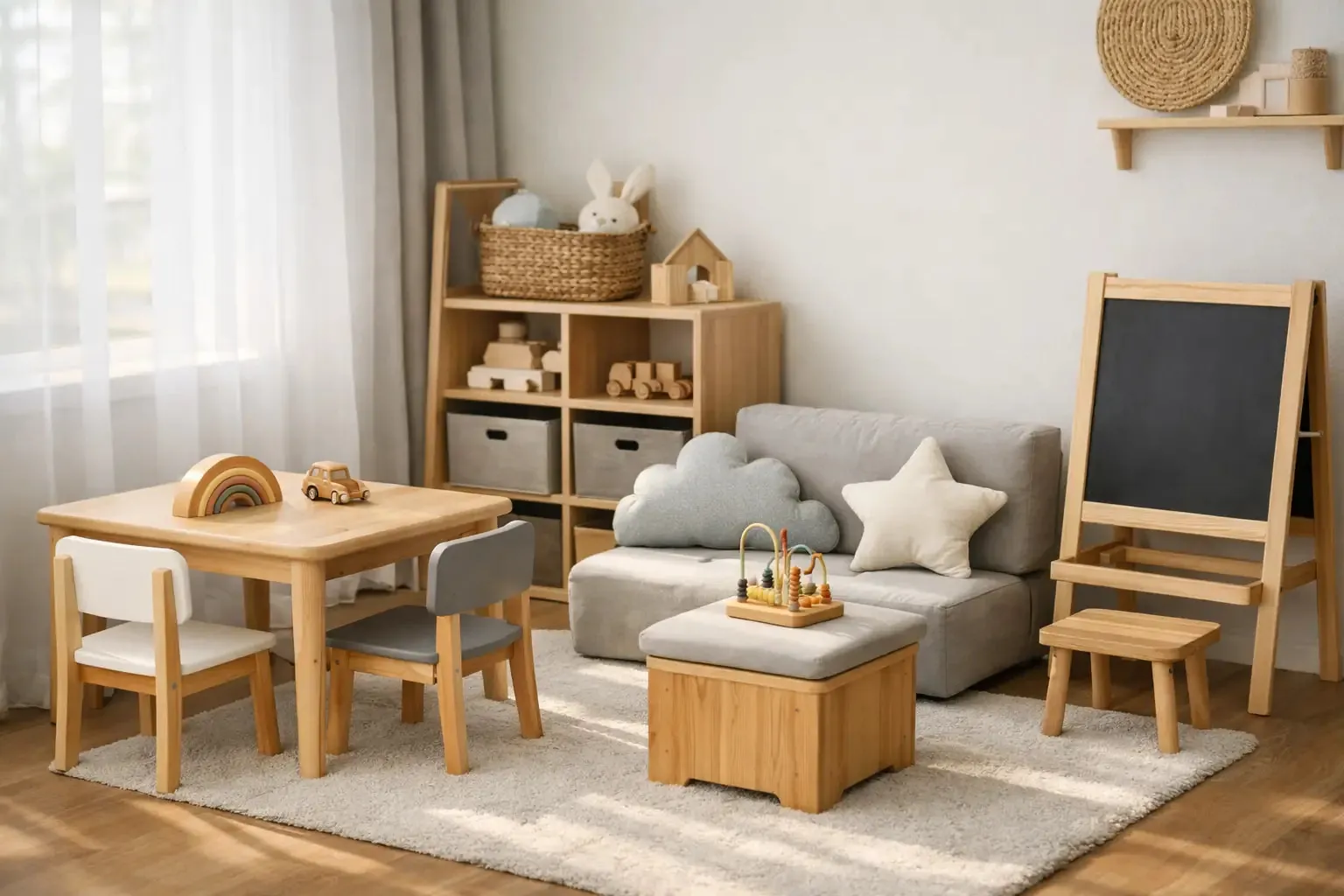
Tables, chairs, and learning furniture Compact table and chair sets A toddler table can be a smart buy if your child colors, snacks, does puzzles, or uses Montessori-style activities at home.
In a small room, though, size matters more than style.
The best sets are compact enough to fit in a corner and light enough to move when needed.
Round tables may soften the layout in a tight room, while square tables can sit flush against a wall more easily.
Chairs should slide fully under the table when not in use.
If they stick out too far, they can quickly turn a useful setup into an obstacle course.
If you only have room for one activity piece, a table with storage underneath or a multipurpose top is often the better choice.
You want something that can handle art time, reading, and play instead of needing separate stations for each.
Toddler kitchen helpers and step stools Not all toddler furniture has to stay in the bedroom.
If your home is short on space overall, a foldable or slim step stool can be one of the most useful toddler pieces you buy.
It gives children access to sinks, bathroom counters, and kitchen workspaces without needing a larger helper tower in every room.
A full toddler tower is great for families who cook often with their child, but it does take up more floor space.
In a small apartment or compact kitchen, a lightweight folding option may be easier to store.
The trade-off is stability and daily convenience.
If your toddler uses it several times a day, a sturdier standing helper may still be worth the space.
How to choose the best toddler furniture for small spaces Start by measuring the room, then measure the walking paths inside it.
Parents often focus on whether a piece fits against the wall, but what matters just as much is whether you can still move through the room easily.
Leave enough clearance for doors, drawers, and bedtime routines.
If toys are the main problem, prioritize storage before adding extra seating or decor.
If your child does everything on the floor and you want a more organized setup, a small table may have more impact than another shelf.
Toddlers outgrow furniture quickly, so versatility matters.
A very tiny chair with a themed design may not.
In small spaces, neutral, functional pieces usually give you more flexibility as your child grows.
Material and cleanup should not be overlooked.
Painted wood, sealed surfaces, and wipe-clean finishes are usually the easiest to live with day to day.
Fabric-upholstered toddler pieces can look cozy, but they are harder to keep clean in rooms where snacks, markers, and sticky hands are part of daily life.
Common mistakes that make a small room feel smaller One common mistake is buying a matching furniture set.
It may seem convenient, but full sets are often designed to fill a room, not save space.
In a compact bedroom, mixed pieces usually work better because you can choose exactly what fits your layout.
Another mistake is choosing furniture that is too tall.
Vertical storage can be helpful, but oversized pieces can dominate a small child’s room and make it feel closed in.
Lower furniture keeps the room more open and easier for toddlers to use independently.
A small room does not need a bed, table, reading chair, toy chest, bookshelf, and dress-up station all at once.
Usually, two or three well-chosen pieces do more than a full room of small furniture that barely gets used.
A simple way to build a better toddler setup If you are starting from scratch, keep it basic.
Choose a bed that fits the room without crowding it, add one good storage piece, and then decide if your child truly needs a table, bookshelf, or stool.
That approach keeps shopping easier and helps you avoid spending money on furniture that looks useful but ends up in the way.
For many families, the best toddler furniture for small spaces is not the cutest or the most elaborate.
It is the furniture that makes mornings smoother, cleanup faster, and playtime easier to manage in the room you actually have.
If a piece saves space and gets used every day, it is doing its job well.
A small room can still work beautifully for a toddler when each piece has a reason to be there.